
Missouri State University

Skip search and site index

Office of University Communications 

Missouri State settles lawsuit with Emily Brooker

Date: November 8, 2006
Contact: John Black, (417) 836-8507
Dr. Michael T. Nietzel, (417) 836-8500

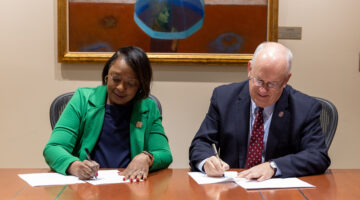
SPRINGFIELD — Missouri State University today signed an out-of-court agreement with the Alliance Defense Fund, thus ending the lawsuit filed against the university by Emily Brooker.

On Oct. 30, the Alliance Defense Fund posted on its website a news release with a link to a lawsuit filed by Brooker. In the lawsuit, Brooker claimed that before she graduated from Missouri State in May 2006 with her undergraduate degree in social work, her free speech and religious rights had been violated in two social work classes. Missouri State University officials have spent the past several days investigating the allegations and discussing the case with the Alliance Defense Fund.

According to the terms of the settlement, Missouri State agrees to the following:

  • clear Brooker's official record of the Social Work Level 3 review referenced in the complaint.
  • pay Brooker an amount of $9,000 and she will be responsible for her own legal fees.
  • waive academic fees at Missouri State University, or in lieu thereof, reimburse an amount equal to two years of degree work toward a Master of Social Work degree (or a graduate degree of equivalent length) at any public institution in the state, which is estimated at approximately $12,000, plus Brooker will receive $3,000 per year in living expense for two years of graduate education.

"We acted on these allegations as soon as we became aware of them the afternoon of Oct. 30," said Missouri State President Michael T. Nietzel. "Although our investigation did not support all of the allegations made in the lawsuit, we were concerned about some of the actions that we did learn about."

In addition to the terms of the lawsuit, Nietzel also announced that based on the university's investigation, he believed it was important for the university to take a number of other steps that addressed broader issues. They include the following:

  • Nietzel will commission a comprehensive, professionally directed evaluation of the Missouri State Social Work Program. He has asked Provost Belinda McCarthy to identify an outside group of social work education experts who will be charged with this review. "It is important for current and prospective students, for potential employers, and for the faculty and staff in the program to have confidence that the policies, procedures, leadership, and delivery of the program are up to par," said Nietzel. "The reviewers will have the complete cooperation of the university as they conduct their assessment. We will begin to recruit this external team immediately with the hope that they can visit us and conduct the review in the spring 2007 semester."
  • Dr. Frank G. Kauffman, assistant professor of social work, has voluntarily stepped down from his administrative duties as director of the Master of Social Work Program. In addition, he has been re-assigned to non-classroom duties in the School of Social Work for the remainder of the fall semester. Finally, Kauffman has begun weekly consultations with Associate Provost Chris Craig, which will continue at least through the spring 2007 semester.
  • Finally, Nietzel will appoint an ad hoc committee to recommend ways in which the university can better publicize and more effectively implement its policies regarding freedom of speech and expression on campus. "The Declaration of Community Principles and the Statement of Student Rights adopted by Missouri State a number of years ago are very good and powerful statement of rights and responsibilities," said Nietzel. "And, we have strong and effective grievance policies in place. We need to make sure that all members of the campus community, especially new members, are familiar with the Principles and the policies. When we talk about making sure that a Missouri State education is rigorous, part of that is the recognition that the content, theories, and implications of any number of academic disciplines often engender vigorous debate and can sometimes conflict with personal beliefs. How these controversies and how the inevitable clashes of personal convictions and values are raised and addressed are crucial questions for a university. Ultimately, universities must be responsible for providing an environment that promotes learning and that permits individuals to exchange ideas in honest and civil ways. That is our goal."